
Updated Emergency Medicine Protocols in School
Following a review of our medical procedures, we have updated our Emergency Medicine Protocol to ensure it reflects the wide range of opportunities available to pupils across and beyond the school day. Pupils now regularly move between classrooms, outdoor spaces, clubs, and enrichment activities, creating multiple transition points throughout the day. The updated system has been designed to ensure that medication remains safe, accessible, and consistently managed across all of these contexts, with clear responsibilities for staff, pupils, and external providers.
On Monday we will introduce an updated system to ensure that all emergency medication is always accessible to children throughout the school day, including before and after-school activities and trips and activities off site.
Our system is based on a simple principle:
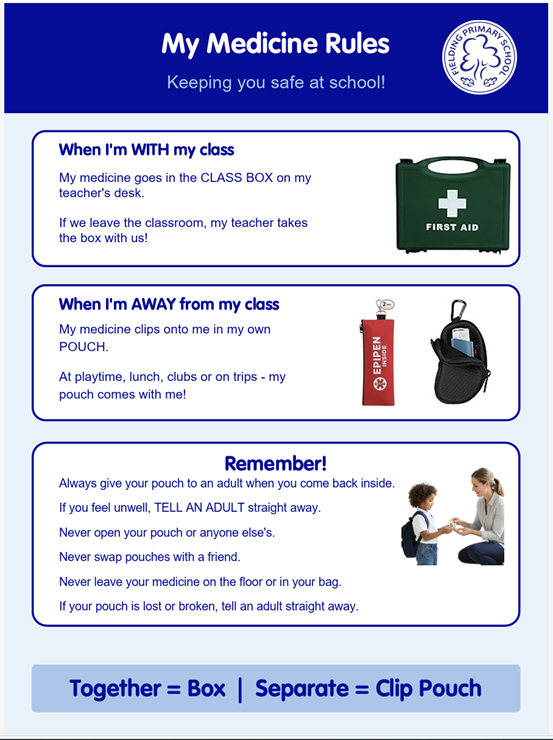
- When children are with their class – medication is stored in a clearly labelled class medical box kept on the teacher’s desk and travels with the class
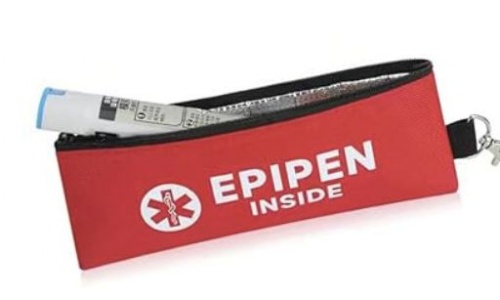
- When children are away from their class (e.g. playtime, lunch, clubs, or trips) – life-saving medication (such as epipens and inhalers) is carried by the child in a secure clip-on pouch.
This ensures that life-saving medication is always immediately available, even across our large and busy school site. The 'My Medicne Rules' will be introduced to children in assemblies on Monday.
Risk Assessment and Safety Assurance
We have carefully reviewed and risk assessed how medication is stored, moved, and accessed throughout the day, particularly in light of the multiple transition points pupils experience. This includes classrooms, playgrounds, clubs, and off-site visits & events. The system ensures that life-saving medication is immediately accessible at all times by the responsible adult, while also taking into account the age of pupils and the practical realities of a dynamic school environment.
Adjustments have been made where appropriate, for example, ensuring that liquid antihistamines are stored securely and accessed by adults rather than carried by children. Clear procedures are in place for handovers between different parts of the day, as well as for supervision, storage, and emergency response. All staff are trained and understand their responsibilities. These updated arrangements will be regularly monitored and reviewed.
Emergency backup medication is also kept in school and will be used only where appropriate and with parental consent.
Training on asthma and anaphylaxis will be rolled out to specialist club providers from this week (where training has not yet taken place).
This approach ensures that risks are minimised while enabling pupils with medical needs to fully participate in the wide range of activities offered throughout the school day.
Key points for parents
- Your child’s epipen (adrenaline auto-injector) and inhaler will be kept in school and managed through this system
- Pupils will carry these in a clip-on pouch when they are not with their class, for example, when going to an after-school club, or at lunchtime. The youngest pupils will be supported to to this.
- Help us by ensuring your child has a belt loop or similar on their uniform that their medication pouch can be clipped to. We will also have cross-body straps for pouches to be strapped to (just waiting on delivery!)
- All adults (staff, specialist club providers, EMS tutors) will know which children have emergency medication in school and will check each child has it with them when they are with them.
- Liquid antihistamines are not carried by pupils. These are stored in the class medical box and centrally in the school medical room. During on-site clubs, antihistamines are accessed from the medical room by staff when needed. During off-site visits, such as trips or sports events, adults will carry this medication with them.
Parental Responsibilities
As parents, you play a vital role in keeping children safe. Please
- Keep us fully informed of any medical needs, diagnoses or changes in your child’s condition
- Provide all required medication (e.g. Epipens, inhalers, antihistamines) promptly when requested including replacing medication when used or nearing expiry
- Ensure medication is in date and clearly labelled with your child’s name & class
- Complete and keep up to date any consent forms you are given to complete/online
If your child has medical needs, please be assured that these procedures are in place to ensure their safety at all times. As with all new systems, there may be teething problems that we will need to resolve. Please bear with us as we work through these.
Clare Haines